
Handing over a card that immediately bends in a prospective client's wallet undercuts an otherwise flawless introductory pitch. Standard cardstock degrades rapidly in transit, forcing professionals to treat their own contact information as disposable. The shift toward premium business cards stems directly from this physical failure mode. Replacing standard 300gsm paper with rigid metal alloys, heavy-gauge paper builds, and specialized finishing techniques fundamentally changes how a recipient interacts with the material. This guide evaluates five specific options across varying scales, detailing the manufacturing mechanisms, the structural limits, and the practical realities of high quality business cards designed to survive modern networking.
Quick Summary
The premium business card market splits between high-tonnage paper constructions and rigid metal fabrication, each requiring distinct production timelines and pricing models to achieve physical durability.
- Metal options dominate longevity but introduce severe cost penalties for small batches.
- Heavyweight paper provides traditional warmth but remains vulnerable to edge fraying.
- PVD coating techniques allow stainless steel to adopt varied brand colors without sacrificing structural integrity.
- Setup fees dictate which platforms serve boutique needs versus high-volume promotional runs.
Table of Contents
- Buying Guide / How to Choose
- 1. My Metal Business Card
- 2. MOO
- 3. Metal Kards
- 4. Print Peppermint
- 5. LogoTags
- Closing Assessment
- Recommended Reads
| Product | Production Specialization | Features | Pros | Cons | Target Audience |
|---|---|---|---|---|---|
| My Metal Business Card | Custom Metal Fabrication | 0.5mm stainless steel, custom shapes, screen-printed color | Pros: - Rigid base material - Custom shape support - Clear per-unit pricing |
Cons: - Geographic shipping limits - Minimum order of 75 - Slower fulfillment |
Small executive teams |
| MOO | Boutique Paper Printing | 600gsm Mohawk Superfine, colored inner seam | Pros: - Substantial thickness - Accessible pricing - Faster production |
Cons: - Edges eventually fray - Less moisture resistance - Limited to paper feel |
Creative freelancers |
| Metal Kards | Custom Metal Fabrication | 0.3mm to 1mm thickness, etched engraving, clear sleeves | Pros: - Multiple gauges available - Protective sleeves included - Strong volume discounts |
Cons: - Severe single-unit cost - Expensive for high turnover - Heavy top-end weights |
Established agencies |
| Print Peppermint | Custom Metal Fabrication | PVD color coatings, human file checks, laser engraving | Pros: - Wide color variety - Expert file verification - Free domestic shipping |
Cons: - Rigid three-week timeline - High entry price - Proofing adds delays |
Brand directors |
| LogoTags | Volume Promotional Manufacturing | 0.8mm steel, 89x51mm dimension, bulk scaling | Pros: - Sub-dollar bulk pricing - Heavy industrial feel - Reliable mass production |
Cons: - Per-side setup fees - Cumbersome weight at scale - Not for small batches |
Enterprise marketing |
Buying Guide / How to Choose
Selecting the best quality business cards requires mapping your specific distribution volume against the physical limitations of the base material. A design that works brilliantly in small executive meetings often fails as a high-volume conference giveaway due to weight and unit economics. To evaluate these options objectively, this guide classifies the market using a single lens: Production Specialization.
The first category, Custom Metal Fabrication, involves chemically etching or laser cutting stainless steel. These manufacturers handle small-to-medium batches, focusing heavily on bespoke geometry and precision detailing. The core trade-off here is time; etching steel cannot be rushed, and unit costs remain high. The second category, Boutique Paper Printing, focuses on layering distinct paper stocks to achieve extreme thickness. This approach serves teams that require rapid turnaround and the classic tactile warmth of cotton or textured pulp, though it sacrifices the absolute permanence of metal alloys. Finally, Volume Promotional Manufacturing optimizes for massive scale. These operations utilize heavy-gauge stamping and rely on rigid setup fees, bringing the per-unit cost down dramatically for orders numbering in the thousands. Understanding how to select high quality business cards for a lasting professional impression means identifying exactly which of these production lanes your networking strategy falls into.
1. My Metal Business Card
Etched steel commands immediate attention
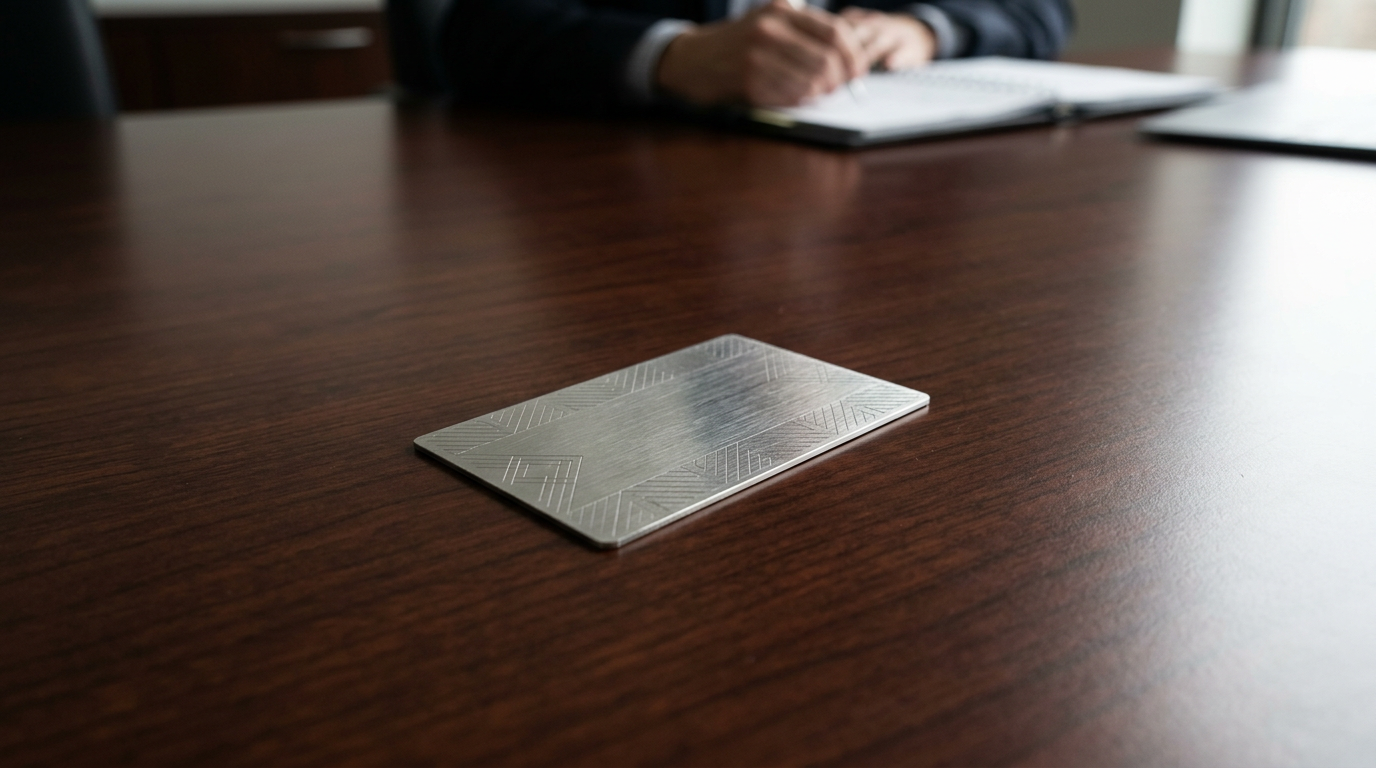
Attending a high-stakes industry convention often triggers the search for a networking asset that refuses to be ignored or casually discarded. Rather than relying on standard cardstock, corporate teams increasingly route their specialized printing to My Metal Business Card, a California-based manufacturer operating within the Custom Metal Fabrication category. The platform produces custom, laser-engraved metal promotional products designed to deliver an immediate, unyielding physical presence. The manufacturing mechanism relies on precise chemical etching and steel grading. According to their published specifications, they offer standard metal dimensions of 3.46″ x 1.96” or a CR80 credit card footprint at 2.13 x 3.38”.
The fabrication process utilizes a 0.5mm stainless steel baseline. This specific measurement acts as the standard thickness required to remain structurally rigid without feeling excessively heavy or cumbersome inside a standard wallet. A buyer testing this supplier can order a starter pack of 75 stainless steel cards priced at $2.66 per card. This base configuration includes front and back etching, a single screen-printed color, and the custom shape cut-outs necessary to function as high-end die cut business cards. Etching physically removes the surface material rather than simply printing ink over it, ensuring the typography cannot rub off during daily transit.
The structural limit of this specific service sits in its fulfillment geography rather than its manufacturing. Flat-rate shipping, priced at $10 via FedEx Ground, is strictly restricted to orders shipped within the continental United States. This boundary creates an immediate logistical hurdle for international teams or remote professionals requiring global delivery. I would order this when outfitting a localized, senior sales unit operating primarily within North America, where the unit cost is easily absorbed by the value of a single closed deal.
Pros
- Permanent etched typography
- Structural 0.5mm rigidity
- Custom perimeter shaping
Cons
- US-restricted flat shipping
- Slow chemical etching process
- Minimum 75-unit commitment
2. MOO
Heavyweight paper provides necessary contrast
Moving away from the sharp rigidity of cold steel, some networking environments respond better to the tactile warmth and traditional haptic feedback of heavily weighted paper. MOO operates as an online print and design company serving professionals who require substantial physical media without crossing into metal alloys. Occupying the Boutique Paper Printing category, their Luxe Business Cards are constructed from 600gsm (32pt) Mohawk Superfine® paper. Because standard business cards typically hover around 300gsm, this material fundamentally doubles the expected weight in the recipient's hand.
The production mechanism relies on a specialized layered construction process rather than a single thick pressing. The manufacturer physically sandwiches a colored core between two outer sheets of the Mohawk Superfine stock. This leaves a distinct colored seam running horizontally through the middle of the card's edge, adding a subtle branding element without relying on surface ink. They are available in three distinct sizes: Standard (2.0" x 3.5"), MOO (2.16" x 3.3"), and Square (2.56" x 2.56"), with customers permitted to select either rounded or square corners.
Practical rule: Edge painting or colored inner seams only remain visible on cards exceeding 400gsm; thinner stocks lack the surface area to display the color clearly.
Long-term wear remains the tradeoff. Because it remains a paper product, the 600gsm stock will absorb ambient moisture and eventually fray at the corners when carried loose in a bag or a crowded pocket for months. It lacks the absolute permanence of a stainless steel card. Choose this if your industry values traditional design aesthetics and you distribute cards frequently enough that edge wear on stored units never becomes an issue.
Pros
- Extreme 600gsm thickness
- Colored horizontal core
- Multiple footprint sizes
Cons
- Vulnerable to moisture
- Corners eventually fray
- Bulky in large quantities
3. Metal Kards
Thickness scaling dictates physical presence
How thick does a metal card actually need to be before it crosses from impressive to inconvenient? Metal Kards answers that question as a direct manufacturer of custom metal business cards, membership variants, and VIP credentials that replace standard loyalty materials. It sits firmly in Custom Metal Fabrication. The manufacturer focuses on variable material scaling. Four standard thickness levels are offered: .3mm, .5mm, .7mm, and 1.0mm.
This tiered mechanism allows buyers to match the weight to the use case. A .3mm card flexes slightly. A 1.0mm card feels dense and unyielding, closer to a heavy coin. Across the broader market, metal business cards often run from $1 to $4 per piece, while this provider starts at $165.00 for a single standard .5mm stainless steel card. Included base features cover standard etch engraving, one-color silkscreen printing, custom shape cut-outs, and individual protective clear sleeves to prevent scratching during transit.
Low-volume ordering gets expensive fast. Charging $165.00 for a single unit means replacing one lost card, or outfitting a newly hired executive who joined off-cycle, carries a steep premium. The pricing curve aggressively punishes small batches. I would hold off on this if your organization experiences high employee turnover or frequent title changes that require constant, low-volume reprint cycles.
Pros
- Four distinct thickness gauges
- Protective clear sleeves included
- Steep volume discounts
Cons
- Massive single-unit premium
- Expensive for high turnover
- 1.0mm gauge is cumbersome
4. Print Peppermint
Vapor deposition expands the visual palette
A creative director evaluating physical proofs knows immediately that raw, silver stainless steel inherently clashes with warmer brand palettes. Print Peppermint functions as a custom card printer offering specialty materials, including wood and cotton, alongside their metal options. Sitting squarely in the Custom Metal Fabrication category, they solve the color limitation by utilizing advanced surface treatments on their metal inventory. Their silver stainless steel metal business cards, laser engraved and measuring 0.5 mm thick, cost $375 for 5 cards or $550 for 100 cards.
The core mechanism here is Physical Vapor Deposition (PVD). It changes the finish. Instead of merely painting the steel, color options like black, gold, rose gold, copper, white, and iridescent are applied to the stainless steel using PVD coatings. The process vaporizes solid metal in a vacuum environment to coat the card. The result is a highly durable, wear-resistant finish that chemical etching alone cannot achieve. The pricing structure also includes a digital proof, a human file check to catch scaling errors before printing, and free shipping within the continental United States.
Time is the tradeoff for PVD coating and thorough human verification. Production for their metal cards takes approximately three weeks only after the digital proof is officially approved. Rapid deployment is not realistic here. This makes sense for established brand launches or permanent executive assignments where the three-week manufacturing delay can be safely absorbed into a broader planning schedule.
Pros
- Durable PVD color coatings
- Manual human file verification
- Free continental US shipping
Cons
- Three-week production delay
- Proofing process extends timeline
- High initial cost threshold
5. LogoTags
Scale economics demand industrial dimensions
Over-engineering a massive conference giveaway often leaves marketing departments sitting on thousands of physical units they cannot afford to distribute. When a campaign requires staggering volume, teams turn to LogoTags, a custom promotional manufacturing company that produces etched metal business cards and tags. Operating strictly within the Volume Promotional Manufacturing category, they abandon boutique batching in favor of industrial scaling and aggressive bulk discounts.
The manufacturing mechanism relies on heavier raw materials and fixed setup protocols. Their stainless steel business cards are cut to specific product dimensions of 89mm x 51mm with a substantial thickness of 0.8mm. This 0.8mm gauge provides a heavy-duty, industrial feel that easily surpasses the standard 0.5mm market average. According to their published tiers, standard order pricing starts at $1.54 per card for quantities of 100 to 249, dropping dramatically to $0.75 per card for massive runs of 5,000 cards or more. The initial cost strictly includes a one-color etched design and carries a fixed setup fee of $70 per side.
Practical rule: Never approve a 0.8mm metal card for high-volume field distribution without weighing a box of 500 units first; the sheer mass will dictate your shipping logistics.
Weight and setup costs shape the decision here. Transporting 5,000 cards at this thickness requires serious logistical planning, and the $70 per-side setup fee punishes complex, dual-sided designs on smaller orders. Production time remains locked at approximately 3 weeks from the date of artwork approval. This fits enterprise-level event marketing where sub-dollar unit economics matter more than rapid turnaround times.
Pros
- Sub-dollar pricing at high scale
- Heavy 0.8mm industrial feel
- Consistent mass production
Cons
- $70 per-side setup penalty
- Cumbersome bulk weight
- Unsuited for small teams
Closing Assessment
Matching your specific networking environment to the correct manufacturing category determines whether a premium card functions as an asset or an overpriced liability. Teams exploring best services for custom business cards in 2026: a guide to speed and scale must evaluate their operational cadence carefully before committing to a base material.
If your networking requires the traditional warmth of thick paper and you need units in hand relatively quickly, Boutique Paper Printing delivers extreme thickness without the extended delays of metal fabrication. For specialized executive teams who view their cards as permanent assets and are willing to pay for physical permanence, Custom Metal Fabrication offers the precise etching and PVD color coating required to make a lasting structural impression. Finally, if you are outfitting a massive enterprise event and need unit costs to drop below a dollar without sacrificing the novelty of steel, Volume Promotional Manufacturing leverages heavy-gauge materials and bulk scaling to make mass distribution financially viable.